Sponsored article
Symbolism of Ars Sacra in the Context of the Liturgical Season: What Sets It Apart?
- How Does Ars Sacra Organize the Meaning of Liturgical Vestments in the Rhythm of the Church Year?
- How Does Liturgical Craft Preserve the Continuity of Ars Sacra Symbolism?
- How Does the Liturgical Season Affect the Choice of Form, Color, and Ornamentation?
- The Consistency of Ars Sacra Symbolism in the Rhythm of the Liturgical Year – An Overview of Key Meanings
In liturgy, nothing functions accidentally or merely decoratively. Every color, embroidery, and form of liturgical vestment is an element of an organized language that the Church has developed over centuries to clearly and consistently express the meaning of the mysteries celebrated. Ars Sacra in this system is a tool of theological communication, closely linked to the liturgical calendar, place of celebration, and function of the serving person. It is within the rhythm of the Church year that the symbolism of sacred art gains particular precision, revealing its role not as ornament but as an integral element of liturgy that organizes the message of faith, strengthens the sacred, and preserves the continuity of tradition.
How Does Ars Sacra Organize the Meaning of Liturgical Vestments in the Rhythm of the Church Year?
The symbolism of Ars Sacra in liturgical seasons is based on a coherent system of signs, colors, and forms, which are subordinate to the official structure of the ecclesiastical year and the theology of liturgy. Each period has its visual narrative, and liturgical vestments become its carrier. Marian chasubles hold a special place in this system because they refer to Marian devotion embedded in specific feasts and commemorations while maintaining consistency with the assigned liturgical color. The meaning of embroidery, cut, and fabric is not an aesthetic addition but a precise theological communication that functions in a specific time, place, and context of celebration. Who wears a particular vestment, during which liturgy, and in which time of the year is crucial for the correct interpretation of symbolism, which does not change by chance but results from the centuries-old tradition of the Church.
How Does Liturgical Craft Preserve the Continuity of Ars Sacra Symbolism?
The durability of Ars Sacra’s message is based on the conscious combination of tradition and craftsmanship, where every element of clerical attire fulfills a specific liturgical and symbolic function. Ars Sacra operates in this area as a continuator of proven patterns, providing vestments in line with liturgical norms and clergy expectations. Handcrafting, high-quality embroidery, and durable fabrics provide not only aesthetics but also the longevity of the symbol, which remains legible through years of intensive use. When and where a particular vestment is used remains closely tied to the liturgical calendar, and its form supports the sacred character of the celebration without dominating its content.
How Does the Liturgical Season Affect the Choice of Form, Color, and Ornamentation?
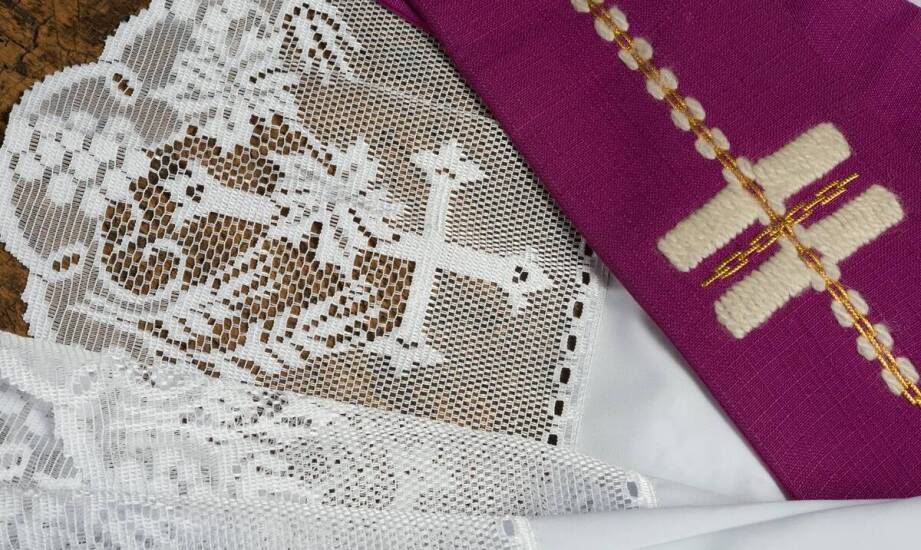
Each liturgical season imposes specific aesthetic and symbolic frameworks that regulate the choice of color, ornamentation, and style of vestments and paraments. Liturgical colors such as white, red, green, or violet create a clear visual code recognizable by clergy and the faithful. Sacred embroidery, Eucharistic, cruciform, or Marian motifs reinforce the theological message while being subordinate to the character of the given time. What is used, by whom, and for what purpose does not result from randomness but from clearly defined liturgical rules. Thus, Ars Sacra maintains the unity of form and content, and liturgical vestments not only adorn the church space but actively participate in conveying the meaning of the celebrated mystery.
The Consistency of Ars Sacra Symbolism in the Rhythm of the Liturgical Year – An Overview of Key Meanings
Symbolism of Ars Sacra develops in the strict order of the liturgical year, from an established system of colors, forms, and signs through the specific selection of liturgical vestments for a given period to the reinforcement of theological message in craft and sacred embroidery. Each liturgical season imparts specific function and meaning to the attire, with their form, ornamentation, and color scheme subordinated to the Church's calendar. In effect, Ars Sacra functions as a continuous, clear, and unchanging language of liturgy, which not only organizes the aesthetics of celebration but primarily reinforces the message of faith, sacredness, and tradition, maintaining consistency between the liturgy's content and its visual expression.
You might be interested

Plastic Sealing – Optimizing Packaging Processes